Salary Sacrifice Changes from April 2029

Salary Sacrifice Changes from April 2029 in the UK
In recent years, salary sacrifice pension contributions have become a widely used and tax efficient way to build retirement savings.
However, the Government has now confirmed changes that will take effect from 6 April 2029.
If you contribute to your workplace pension through salary sacrifice, or your employer offers this arrangement, it is important to understand what is changing and what is staying the same.
This article explains the confirmed position in clear and practical terms.

What Is Salary Sacrifice?

A salary sacrifice arrangement is an agreement between you and your employer.
You agree to reduce your contractual gross salary. In return, your employer pays that amount directly into your pension scheme as an employer contribution.
Because your official salary is lower, this can reduce the amount of Income Tax and National Insurance contributions ou pay. Employers may also save on National Insurance and sometimes add part or all of that saving into your pension.
For many employees, this structure has made pension contributions more efficient compared to paying from net income.

What Is Changing in April 2029?

From 6 April 2029, the Government will introduce a cap on the National Insurance advantages of salary sacrifice for pensions.
Under the new rules:

Gifts and the 7-Year Rule

Only the first £2,000 per tax year of employee pension contributions made via salary sacrifice will be exempt from National Insurance contributions
Any salary sacrifice pension contributions above £2,000 per year will attract National Insurance in the usual way
Income tax relief on pension contributions remains unchanged, subject to existing pension rules such as the annual allowance

Importantly, salary sacrifice itself is not being abolished. You will still be able to use it. The change relates specifically to the National Insurance treatment above the £2,000 threshold.

What Does This Mean in Practice?

For employees who sacrifice up to £2,000 per year into their pension, the current National Insurance treatment will continue.
For those contributing more than £2,000 per year through salary sacrifice, the amount above that threshold will no longer benefit from National Insurance savings. Both employee and employer National Insurance will apply to that excess.
This means the overall tax efficiency of higher pension contributions through salary sacrificemay reduce after April 2029.
However, pension contributions can still receive income tax relief within the normal rules. The wider benefits of disciplined retirement saving remain unchanged.

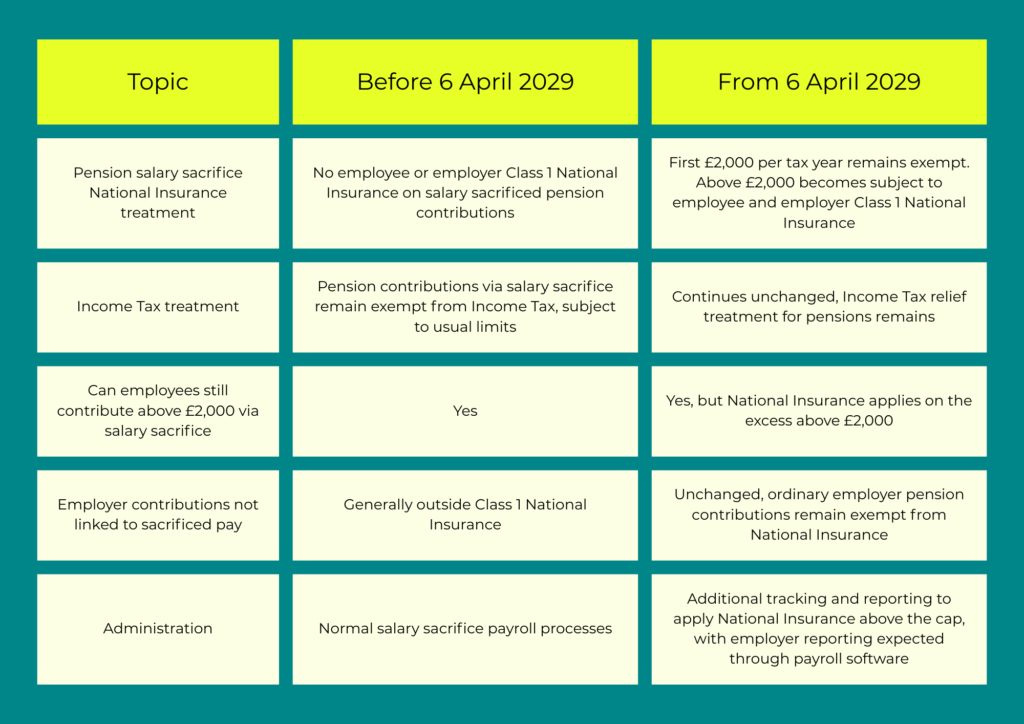
Comparison table for the rule change

Comparison table for the rule change

Should You Change Anything Now?

There is no requirement to make immediate changes purely because of the 2029 reform.

When reviewing your retirement planning strategy, it is sensible to consider:

The level of your current pension contributions
Whether you contribute more than £2,000 per year via salary sacrifice
How pension savings fit into your broader financial goals
The potential impact on take home pay in future

Financial planning works best when it is structured and aligned with your long term objectives rather than driven by short term headlines.

The 2029 change is confirmed, but it is still several years away. That provides time to review your arrangements calmly and make informed decisions where appropriate.

The Bigger Picture

Even with the new National Insurance cap, pensions remain one of the most tax efficient ways to save for retirement in the United Kingdom.
Income tax relief, employer contributions and long term investment growth continue to make pension planning a central part of building financial security.
Understanding how policy changes affect you personally is key. The right course of action will depend on your income level, contribution rate and wider financial position.
If you are unsure how the April 2029 change may affect you, seeking regulated financial advice can provide clarity.

Important information

This article is for general information only and does not constitute financial advice. Pension and tax rules can change and their impact will depend on individual circumstances. Zomi Wealth is authorised and regulated by the Financial Conduct Authority. When investing, your capital is at risk and you may get back less than you invest.

Sources

Stay Connected

For more retirement planning insights, market updates, and tax-saving tips, follow Zomi Wealth on:

Instagram: @ZomiWealth
LinkedIn: Zomi Wealth
X (formerly Twitter): @ZomiWealth
Facebook: Zomi Wealth

Picture of Zomi Wealth

Zomi Wealth

Comments are closed.

Latest posts

Download Our App

Seamlessly manage your finances, invest smarter, and achieve your financial goals with our cutting-edge solutions.

Do you enjoyed this article?

Subscribe to our newsletter for exclusive tips, expert advice, and the latest updates from Zomi Wealth—delivered straight to your inbox.

“Zomi Wealth’’ is a trading name of Zomi Group Limited who are authorised and regulated by the Financial Conduct Authority (FCA), FRN 149309. Past performance is not indicative of future returns. An investor may get back less than the amount invested. Information on past performance, where given, is not necessarily a guide to future performance. The capital value of units in the fund can fluctuate and the price of units can go down as well as up and is not guaranteed. The opinions and views expressed in this newsletter may not necessarily reflect the views of Zomi Group l Limited or its affiliates. The information provided in this newsletter is for informational purposes only and does not constitute a recommendation from any Zomi Group Limited entity to the recipient. Zomi Group Limited is not providing any financial, economic, legal, investment, accounting, or tax advice through this newsletter or to its recipient. Certain information contained in this newsletter constitutes “forward-looking statements,” and there is no guarantee that these results will be achieved. Zomi Group Limited has no obligation to provide any updates or changes to the information in this newsletter. Zomi Group Limited always recommends that the recipient take independent financial advice. Alternative investments often engage in leverage and other investment practices that are extremely speculative and involve a high degree of risk. Such practices may increase the volatility of performance and the risk of investment loss, including the loss of the entire amount that is invested. These investments are usually highly illiquid and generally not transferable without the content of the sponsor.

Investing in cryptocurrency is highly speculative and involves significant risk to capital, as its value is extremely volatile and can fluctuate widely in short periods. It is not regulated by the Financial Conduct Authority, meaning investors may not have access to financial protections, including the Financial Services Compensation Scheme (FSCS) or the Financial Ombudsman Service. There is also a risk of loss from fraud, cybersecurity breaches, or operational failures within cryptocurrency platforms. Investors should carefully consider whether they can afford to lose the entirety of their investment.

Want to know more?

Know more about Zomi Wealth, how we invest, our plans and how to be a part of Zomi Wealth. Contact Us!

Experience the Future of Investments!

Seamlessly manage your finances, invest smarter, and achieve your financial goals with our Zomi Wealth App.

Post Views: 0