Global conflicts can feel unsettling, not only from a human perspective but also for investors trying to make sense of market movements. News cycles often amplify uncertainty, which can lead to concerns about how investments may be affected.
However, history provides a useful lens. By examining past events, we can better understand patterns in stock market performance during war, the role of geopolitical risk in investing, and why maintaining a long term approach remains important.
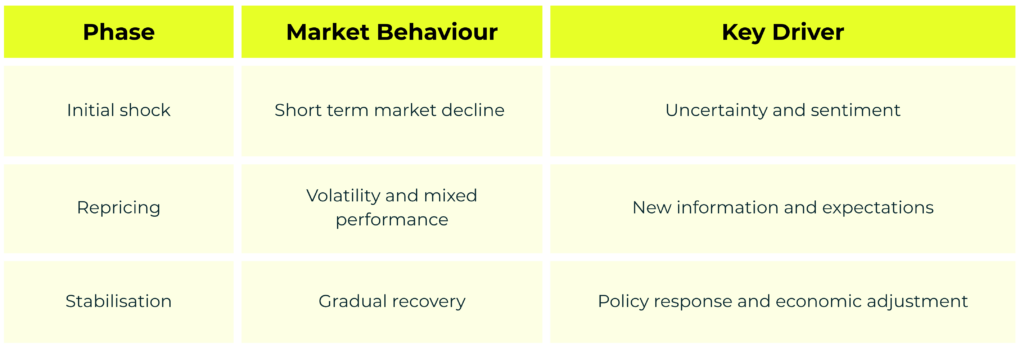
When conflict emerges, markets tend to react quickly. This initial reaction is often driven by uncertainty rather than long term economic damage.
Across many historical events, a broad pattern has been observed:
In many cases, the most significant declines have occurred early, when outcomes are unclear. As more information becomes available, markets often begin to stabilise.
This highlights a key idea in investing during geopolitical uncertainty: markets dislike the unknown more than the event itself.
Energy and commodity supply
Disruptions to oil and gas supply can lead to rising prices, which in turn affect inflation and business costs.
Inflation expectations
Higher energy and food prices can contribute to inflation, influencing central bank decisions.
Interest rates
Changes in inflation expectations may lead to adjustments in interest rates, which can impact both equities and bonds.
Global trade and supply chains
Conflicts that disrupt trade routes or production can affect corporate earnings and economic growth.
Historically, conflicts involving major energy producers have tended to have a more prolonged effect on markets compared to those with limited global economic impact.
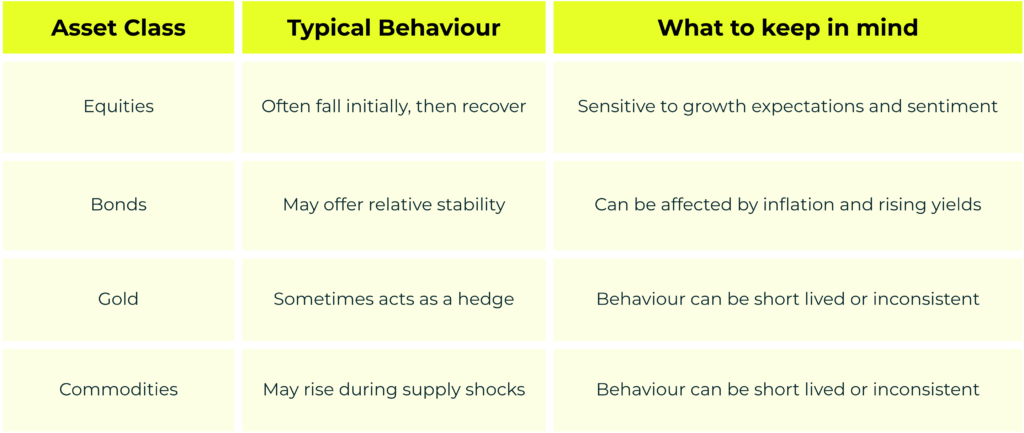
A common question during periods of uncertainty is how to position a portfolio. While there is no guaranteed outcome, history offers some broad observations for asset allocation during geopolitical risk.
It is important to avoid assuming that any asset will always behave in a certain way. Market dynamics change depending on the specific circumstances.
Periods of conflict often lead to increased stock market volatility, not only because of economic uncertainty but also due to human behaviour.
Investors may react emotionally, which can influence market movements:
• Selling investments during downturns
• Attempting to time the market
• Following broader market sentiment rather than long term plans
These behaviours can sometimes result in decisions that do not align with long term financial goals.
A disciplined approach, based on a clearly defined plan, can help manage these challenges.
Government and central bank actions often play a significant role in shaping market outcomes during periods of conflict.
Typical responses may include:
• Supporting financial system liquidity
• Adjusting interest rates
• Introducing economic support measures
These actions are designed to stabilise markets and support economic activity. As a result, markets may begin to recover even while uncertainty remains.
This is one reason why market recovery after geopolitical events can occur sooner than many expect.
While every conflict is different, several consistent lessons can be drawn from history:
Despite short term declines, markets have historically recovered over time.
Reacting to headlines can lead to decisions that are not aligned with long term goals.
Spreading investments across asset classes can help manage risk.
Missing periods of recovery can have a significant impact on long term outcomes.
Investment decisions should always consider individual goals, time horizon and risk tolerance.
It is natural to feel concerned during periods of global conflict. However, history suggests that markets are adaptive. Businesses adjust, economies evolve, and policy responses aim to support stability.
Rather than focusing solely on short term movements, investors may benefit from considering how their strategy aligns with their broader financial objectives.
This article is for general information only and does not constitute investment advice, a personal recommendation, or tax advice.
The value of investments can go down as well as up, and you may get back less than you invest. Past performance is not a reliable indicator of future results.
The suitability of any investment strategy depends on individual circumstances. If you are unsure, you should consider seeking advice from a qualified financial adviser authorised and regulated by the Financial Conduct Authority.
Instagram: @ZomiWealth
LinkedIn: Zomi Wealth
X (formerly Twitter): @ZomiWealth
Facebook: Zomi Wealth


Subscribe to our newsletter for exclusive tips, expert advice, and the latest updates from Zomi Wealth—delivered straight to your inbox.
“Zomi Wealth’’ is a trading name of Zomi Group Limited who are authorised and regulated by the Financial Conduct Authority (FCA), FRN 149309. Past performance is not indicative of future returns. An investor may get back less than the amount invested. Information on past performance, where given, is not necessarily a guide to future performance. The capital value of units in the fund can fluctuate and the price of units can go down as well as up and is not guaranteed. The opinions and views expressed in this newsletter may not necessarily reflect the views of Zomi Group l Limited or its affiliates. The information provided in this newsletter is for informational purposes only and does not constitute a recommendation from any Zomi Group Limited entity to the recipient. Zomi Group Limited is not providing any financial, economic, legal, investment, accounting, or tax advice through this newsletter or to its recipient. Certain information contained in this newsletter constitutes “forward-looking statements,” and there is no guarantee that these results will be achieved. Zomi Group Limited has no obligation to provide any updates or changes to the information in this newsletter. Zomi Group Limited always recommends that the recipient take independent financial advice. Alternative investments often engage in leverage and other investment practices that are extremely speculative and involve a high degree of risk. Such practices may increase the volatility of performance and the risk of investment loss, including the loss of the entire amount that is invested. These investments are usually highly illiquid and generally not transferable without the content of the sponsor.
Investing in cryptocurrency is highly speculative and involves significant risk to capital, as its value is extremely volatile and can fluctuate widely in short periods. It is not regulated by the Financial Conduct Authority, meaning investors may not have access to financial protections, including the Financial Services Compensation Scheme (FSCS) or the Financial Ombudsman Service. There is also a risk of loss from fraud, cybersecurity breaches, or operational failures within cryptocurrency platforms. Investors should carefully consider whether they can afford to lose the entirety of their investment.
Know more about Zomi Wealth, how we invest, our plans and how to be a part of Zomi Wealth. Contact Us!