For many people, the stock market can feel distant or complicated. News headlines often show dramatic movements in markets, which can make investing seem unpredictable or risky.
Yet behind those headlines, stock markets play a simple and important role in the economy. They allow companies to raise money to grow, and they allow individuals to participate in that growth through investing.
Understanding how the stock market works can help you feel more confident when thinking about your financial future.
Imagine a small company that begins with a promising idea. Over time the business grows and needs more money to expand, hire staff, or develop new products.
Instead of borrowing all the money from a bank, the company may decide to sell small ownership shares of the business to the public. These shares are known as stocks or shares.
When a company first offers shares to the public, this is called an Initial Public Offering (IPO). Once listed, those shares can be bought and sold by investors on a stock exchange such as the London Stock Exchange.
In simple terms, the stock market is a marketplace where buyers and sellers trade shares in companies.
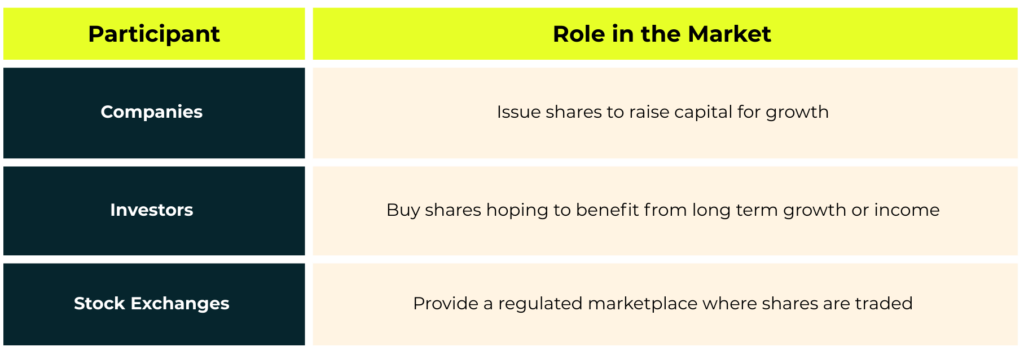
he stock market works through several key participants working together.
This system helps businesses access funding while allowing investors to participate in economic growth.
Once shares are listed on an exchange, investors can buy or sell them through an investment platform or broker.
Prices change constantly based on supply and demand. If many investors want to buy a company’s shares, the price may rise. If more investors want to sell than buy, the price may fall.
Several factors can influence share prices, including:
• company performance
• economic conditions
• investor expectations
• interest rates
• global events
Because of these influences, stock market prices can move up and down over time.
Below is a simplified flow showing how companies and investors interact in the market.
Company needs capital
↓
Company issues shares through an Initial Public Offering
↓
Shares listed on a stock exchange
↓
Investors buy and sell shares through brokers
↓
Share prices change based on demand and market information
Investors often use the stock market as part of a long term financial plan. There are generally two potential ways investors may benefit.
If a company grows and becomes more valuable, the price of its shares may increase over time.
Some companies distribute a portion of their profits to shareholders in the form of dividends.
However, not all companies pay dividends and future payments cannot be guaranteed.
Stock markets rarely move in a straight line. Prices can rise or fall over short periods due to economic news, global events, or investor sentiment.
This movement is often referred to as market volatility.
For long term investors, it is often helpful to view market movements in the context of a broader investment strategy rather than reacting to short term changes.
Diversification, regular investing, and maintaining a long term perspective are commonly discussed principles in investment planning.
Today, investors can access the stock market in several ways, including:
• individual company shares
• exchange traded funds (ETFs)
• investment funds
• pension investments
Each option offers different levels of diversification, risk, and complexity. The suitability of any investment approach will depend on an individual’s circumstances and financial objectives.
Learning how the stock market works can help investors make more informed financial decisions. While investing involves risk, markets have historically played a role in supporting long term wealth building for many investors.
Understanding the basics can turn what once felt complex into something far more accessible.
At Zomi Wealth, conversations often begin with education and clarity. Building confidence in financial decisions often starts with understanding how the systems behind investing operate.
This article is provided for general information purposes only and does not constitute financial advice or a recommendation to invest. Investments can fall as well as rise in value, and you may get back less than you invest. The suitability of any investment will depend on your individual circumstances. If you are unsure about an investment decision, consider seeking advice from a qualified financial adviser.
Instagram: @ZomiWealth
LinkedIn: Zomi Wealth
X (formerly Twitter): @ZomiWealth
Facebook: Zomi Wealth


Subscribe to our newsletter for exclusive tips, expert advice, and the latest updates from Zomi Wealth—delivered straight to your inbox.
“Zomi Wealth’’ is a trading name of Zomi Group Limited who are authorised and regulated by the Financial Conduct Authority (FCA), FRN 149309. Past performance is not indicative of future returns. An investor may get back less than the amount invested. Information on past performance, where given, is not necessarily a guide to future performance. The capital value of units in the fund can fluctuate and the price of units can go down as well as up and is not guaranteed. The opinions and views expressed in this newsletter may not necessarily reflect the views of Zomi Group l Limited or its affiliates. The information provided in this newsletter is for informational purposes only and does not constitute a recommendation from any Zomi Group Limited entity to the recipient. Zomi Group Limited is not providing any financial, economic, legal, investment, accounting, or tax advice through this newsletter or to its recipient. Certain information contained in this newsletter constitutes “forward-looking statements,” and there is no guarantee that these results will be achieved. Zomi Group Limited has no obligation to provide any updates or changes to the information in this newsletter. Zomi Group Limited always recommends that the recipient take independent financial advice. Alternative investments often engage in leverage and other investment practices that are extremely speculative and involve a high degree of risk. Such practices may increase the volatility of performance and the risk of investment loss, including the loss of the entire amount that is invested. These investments are usually highly illiquid and generally not transferable without the content of the sponsor.
Investing in cryptocurrency is highly speculative and involves significant risk to capital, as its value is extremely volatile and can fluctuate widely in short periods. It is not regulated by the Financial Conduct Authority, meaning investors may not have access to financial protections, including the Financial Services Compensation Scheme (FSCS) or the Financial Ombudsman Service. There is also a risk of loss from fraud, cybersecurity breaches, or operational failures within cryptocurrency platforms. Investors should carefully consider whether they can afford to lose the entirety of their investment.
Know more about Zomi Wealth, how we invest, our plans and how to be a part of Zomi Wealth. Contact Us!