How inflation affects your investments

How inflation affects your investments

Inflation is something we all experience, from rising grocery bills to higher energy costs. But beyond everyday expenses, inflation plays a significant role in shaping your financial future, particularly when it comes to your investments.

Understanding how inflation and investments interact can help you make more informed decisions and stay focused on your long term financial goals.

What is Inflation?

Inflation refers to the general increase in prices over time, which reduces the purchasing power of money. In simple terms, £100 today may not buy the same amount of goods or services in the future.

For investors, this creates an important challenge. If your investments do not grow at a rate higher than inflation, the real value of your money may fall over time.

Why Inflation Matters for Investors

Let’s consider a simple example.

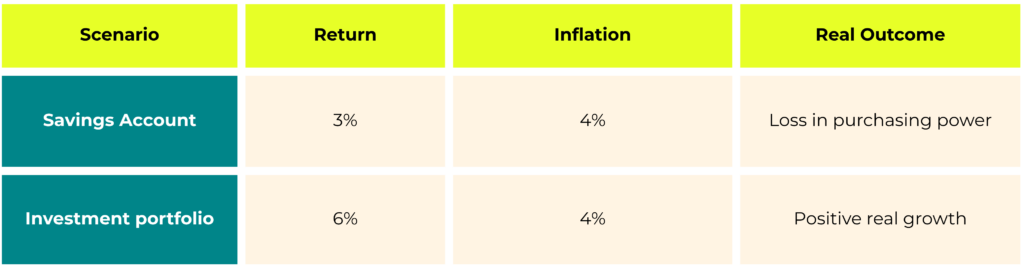
If your savings grow by 3 percent annually, but inflation is running at 4 percent, your real return is actually negative.

Why Inflation Matters for Investors

This highlights a key principle of investment planning. It is not just about returns, but about returns after inflation.

How Inflation Impacts Different Investments

Not all assets respond to inflation in the same way. Understanding these differences can help you build a more resilient portfolio.

1. Cash Savings
Cash held in savings accounts is often the most affected by inflation. While it offers stability, it may struggle to keep pace with rising prices over the long term.

Key takeaway: Holding too much cash may reduce your purchasing power over time.

2. Bonds
Fixed income investments such as bonds can be sensitive to inflation. When inflation rises, the fixed interest payments they provide may become less valuable in real terms.

Key takeaway: Inflation can erode the real income generated by bonds.

3. Equities
Shares in companies, also known as equities, have historically provided the potential for growth that can outpace inflation over the long term. Companies may increase prices, which can support earnings growth.

However, this is not guaranteed, and market values can fluctuate.

Key takeaway: Equities may offer inflation protection over time, but come with investment risk.

4. Property and Real Assets
Assets such as property or infrastructure may have the potential to rise in value alongside inflation, particularly where income such as rent can increase over time.

Key takeaway: Some real assets may provide a hedge against inflation, but values can go down as well as up.

A Simple Illustration

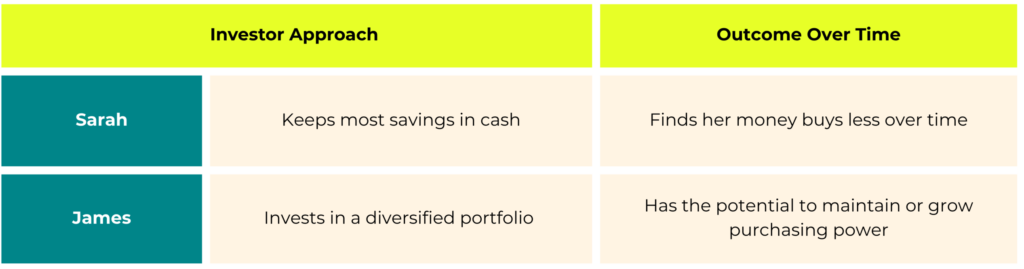
Imagine two individuals, Sarah and James.

A Simple Illustration - Investor Approach

This example is for illustrative purposes only and does not represent actual investment performance.

Strategies to Manage Inflation Risk

While inflation cannot be controlled, there are ways to manage its impact through thoughtful financial planning.

Diversification
Spreading investments across different asset types may help reduce risk. A diversified portfolio can include equities, bonds, and other assets.

Long Term Perspective
Investing with a long term horizon may help smooth short term fluctuations caused by inflation and market movements.

Regular Reviews
Reviewing your investment strategy regularly ensures it remains aligned with your goals and economic conditions.

Staying Focused on What Matters

Inflation is a natural part of the economic cycle. While it can create uncertainty, reacting impulsively to short term changes may not always be beneficial.

A structured and disciplined approach to wealth management can help you stay on track.

Final Thoughts

Inflation affects every investor, but understanding its impact is the first step towards managing it effectively.

Rather than trying to predict short term movements, focusing on a well considered investment strategy aligned with your personal goals may provide a more stable path forward.

Important information

This article is for general information only and does not constitute financial advice. The value of investments can go down as well as up, and you may not get back the amount originally invested. Past performance is not a reliable indicator of future results. If you are unsure about your financial situation, you should consider seeking advice from a qualified financial adviser.

Sources

Stay Connected

For more retirement planning insights, market updates, and tax-saving tips, follow Zomi Wealth on:

Instagram: @ZomiWealth
LinkedIn: Zomi Wealth
X (formerly Twitter): @ZomiWealth
Facebook: Zomi Wealth

Picture of Zomi Wealth

Zomi Wealth

Comments are closed.

Latest posts

Download Our App

Seamlessly manage your finances, invest smarter, and achieve your financial goals with our cutting-edge solutions.

Do you enjoyed this article?

Subscribe to our newsletter for exclusive tips, expert advice, and the latest updates from Zomi Wealth—delivered straight to your inbox.

“Zomi Wealth’’ is a trading name of Zomi Group Limited who are authorised and regulated by the Financial Conduct Authority (FCA), FRN 149309. Past performance is not indicative of future returns. An investor may get back less than the amount invested. Information on past performance, where given, is not necessarily a guide to future performance. The capital value of units in the fund can fluctuate and the price of units can go down as well as up and is not guaranteed. The opinions and views expressed in this newsletter may not necessarily reflect the views of Zomi Group l Limited or its affiliates. The information provided in this newsletter is for informational purposes only and does not constitute a recommendation from any Zomi Group Limited entity to the recipient. Zomi Group Limited is not providing any financial, economic, legal, investment, accounting, or tax advice through this newsletter or to its recipient. Certain information contained in this newsletter constitutes “forward-looking statements,” and there is no guarantee that these results will be achieved. Zomi Group Limited has no obligation to provide any updates or changes to the information in this newsletter. Zomi Group Limited always recommends that the recipient take independent financial advice. Alternative investments often engage in leverage and other investment practices that are extremely speculative and involve a high degree of risk. Such practices may increase the volatility of performance and the risk of investment loss, including the loss of the entire amount that is invested. These investments are usually highly illiquid and generally not transferable without the content of the sponsor.

Investing in cryptocurrency is highly speculative and involves significant risk to capital, as its value is extremely volatile and can fluctuate widely in short periods. It is not regulated by the Financial Conduct Authority, meaning investors may not have access to financial protections, including the Financial Services Compensation Scheme (FSCS) or the Financial Ombudsman Service. There is also a risk of loss from fraud, cybersecurity breaches, or operational failures within cryptocurrency platforms. Investors should carefully consider whether they can afford to lose the entirety of their investment.

Want to know more?

Know more about Zomi Wealth, how we invest, our plans and how to be a part of Zomi Wealth. Contact Us!

Experience the Future of Investments!

Seamlessly manage your finances, invest smarter, and achieve your financial goals with our Zomi Wealth App.

Post Views: 4